
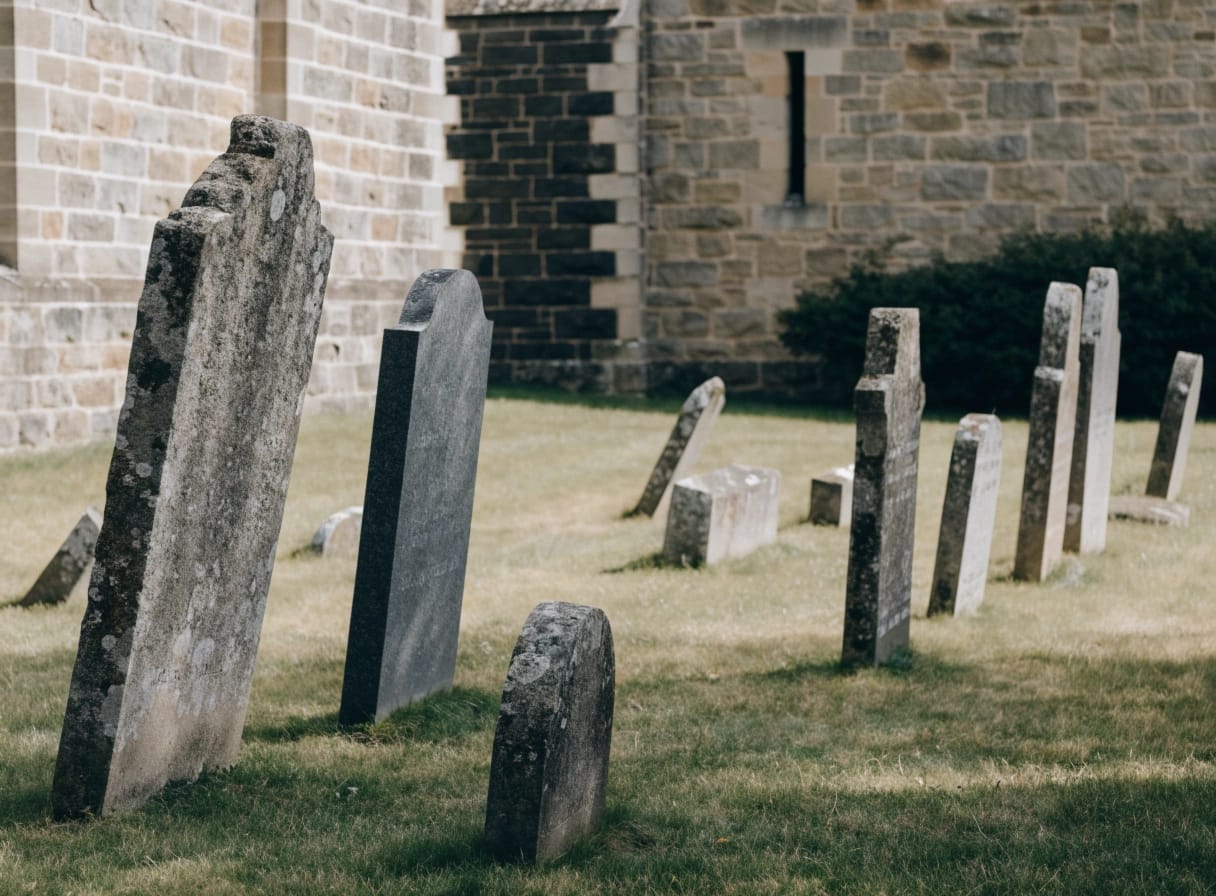
Yes, you need permission before placing a headstone in a churchyard anywhere in England, and the system works the same way in every diocese: the vicar approves it under delegated authority, following that diocese's Churchyard Regulations, or refers it upward for a faculty if it falls outside them. The regulations are set locally by diocese, but the framework itself, and most of what actually gets decided, is remarkably consistent UK-wide.
This guide sets out how the system works wherever you are in the country, what is and isn't typically permitted, and what it costs. If your grave sits in a council or private cemetery rather than a churchyard, a different and separate set of rules applies, covered below too.
Churchyard or Cemetery? The Distinction That Decides Everything
The rules that apply to a memorial depend entirely on where the grave sits. A churchyard is consecrated ground attached to a Church of England church, and any memorial in it falls under the authority of the diocesan Chancellor, delegated in practice to the vicar or priest-in-charge. A cemetery, whether run by a local council or a private operator, is unconsecrated ground governed by that authority's own rules under the Local Authorities Cemeteries Order 1977, or its own conditions of interment if privately run.
The two systems can produce genuinely different answers to the same question. A polished black granite headstone with a photo plaque might be approved without a second glance in a municipal cemetery and refused outright in a churchyard three miles away.
| Churchyard (Church of England) | Local authority or private cemetery |
|---|---|
| Consecrated ground | Unconsecrated ground |
| Permission granted by the vicar, under delegated authority from the diocese | Permission granted by the council or cemetery operator |
| Governed by that diocese's Churchyard Regulations, within a national Faculty Jurisdiction framework | Governed by the Local Authorities Cemeteries Order 1977 and the operator's own rules |
| Dark granite, marble and polished stone generally not permitted | Wider range of materials usually accepted |
| Fee set nationally by the Church of England | Fee set individually by each authority |
| Applications outside the standard rules need a formal faculty | Applications outside the standard rules go back to the authority directly |
💡 Tip: If you are not sure which applies to your situation, the funeral director or the cemetery or churchyard office will confirm it in a phone call. It affects almost every decision that follows, so it is worth establishing early.
The National System: How Churchyard Regulations Actually Work
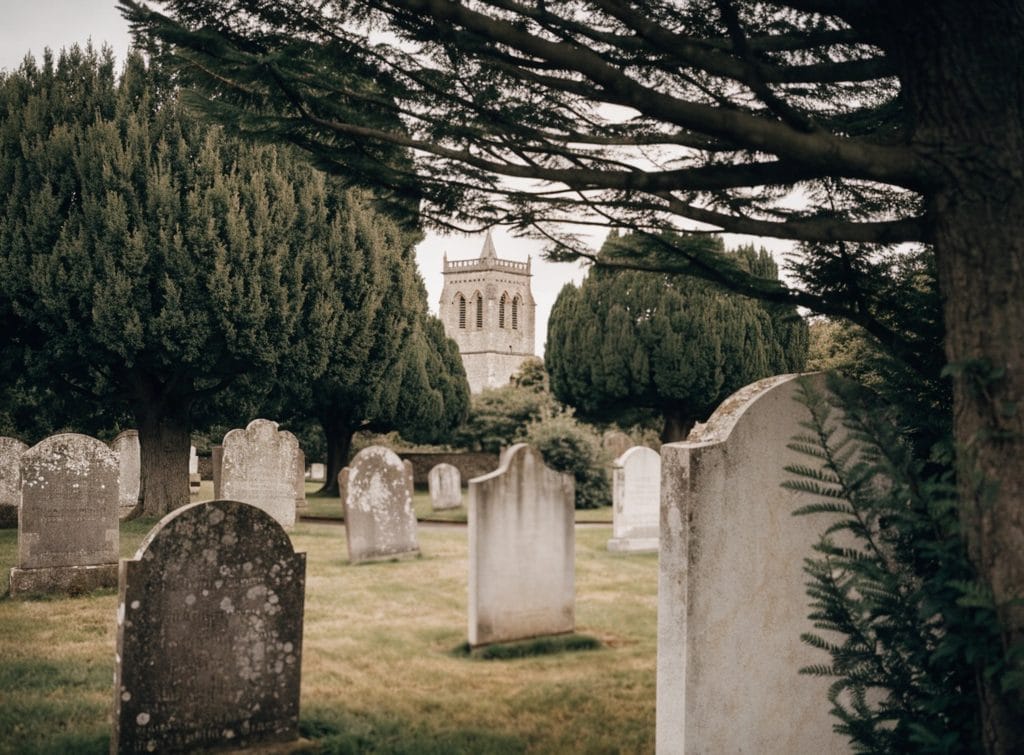
Every one of the 42 dioceses of the Church of England operates under the same national framework, the Faculty Jurisdiction Rules, and issues its own Churchyard Regulations within it. The Church Buildings Council, the Church of England's national body responsible for church buildings and churchyards, publishes statutory guidance that applies everywhere: a period of six months should normally elapse between burial and the erection of a memorial, and headstone design should take account of the churchyard's setting so it does not "stick out."
There is no automatic right to place a memorial in a churchyard, even for family members already buried there. Permission must be sought and granted before any stone is ordered or any work begins, regardless of which diocese the churchyard falls in.
The Standard Steps, Wherever You Are
- Wait the required period. Six months after burial is the national norm, allowing the ground to settle. Individual dioceses may extend this at the incumbent's discretion.
- Choose a design within the standard guidelines. A conventional upright headstone in an approved stone, within the usual dimensions, is the fastest route to approval everywhere.
- Submit a written application. This goes to the vicar or priest-in-charge, usually on a standard diocesan form, describing the size, material, finish and inscription.
- Receive written authorisation. No work should be ordered before this is granted. The authorisation typically permits the memorial to remain for up to 100 years.
If a proposal falls outside the standard guidelines, whether in size, material, shape or inscription, the vicar cannot approve it alone. The application is referred to the Archdeacon or, for anything contentious, to the Chancellor of the diocese, in a process called a faculty. This takes longer and may involve a fee, but it is not a wall. Chancellors regularly grant faculties for well-designed memorials that simply sit outside the standard categories, particularly crosses and hand-carved or contemporary designs.
💡 Tip: Every diocese has a Diocesan Advisory Committee (DAC) that can advise on what's likely to be approved before you commission a design. You can find your diocese and its contact details through A Church Near You, the Church of England's own church finder.
Standard Headstone Dimensions
Diocesan regulations across England converge closely on the same standard dimensions for an upright headstone, which makes this one of the more predictable parts of the process wherever you are in the country.
| Dimension | Standard range |
|---|---|
| Height | 750mm to 1,220mm (2ft 6in to 4ft) |
| Width | 500mm to 915mm (1ft 8in to 3ft) |
| Thickness | 75mm to 150mm (3in to 6in), or 38mm minimum for slate |
| Child's headstone (minimum) | 600mm high, 375mm wide, 50mm thick |
A headstone that falls within these figures is very unlikely to need anything beyond the vicar's standard approval. Anything larger, unusually shaped, or fitted with an integral base wider than around 100mm beyond the stone itself will typically need a faculty. Individual dioceses can and do set slightly different figures, so always check the specific regulations for your churchyard before finalising a design.
What Materials Are Permitted
This is the detail families most often ask about, and the one that generic guides tend to skate over. The Church Buildings Council's own national guidance is direct on this: "Black polished granite, for instance, would not be appropriate in a churchyard full of historic memorials of the local stone." This is a national position, not a quirk of any one diocese.
Across England, the broad pattern of permitted stone is consistent: natural limestone (commonly Portland, Purbeck, York or a regional equivalent), light grey or blue-black slate, and light grey or matt-finished granite. Individual dioceses name their own approved list, often drawn from stone traditionally used in that region's older buildings, which is part of why a mason working across several dioceses needs to check each one rather than assume.
⚠️ Important: Dark or black granite, red granite, marble, and any highly polished or reflective stone finish sit outside the standard permitted list in the great majority of English dioceses. A faculty is required to use them, and while it is not automatically refused, Chancellors are consistently reluctant to grant it.
The reasoning is aesthetic rather than arbitrary. Polished black granite and white marble were not traditionally used in English churchyards, and against centuries of weathered limestone and honed grey granite, they stand out sharply rather than sitting in harmony with the setting. This is a genuinely different standard from most local authority cemeteries, where dark granite and marble are often the most popular choice.
Other Common Restrictions Nationally
- Photographs and ceramic portraits are not permitted without a faculty in most English dioceses, and such a faculty is rarely granted.
- QR codes on gravestones are a genuinely current issue: the Church Buildings Council confirms these generally need a faculty rather than standard approval, partly because a code links to a website outside the church's control.
- Kerbed surrounds, chippings, railings and glass shades require a faculty and are generally discouraged, partly because loose chippings scatter across the grass during mowing.
- Heart-shaped and open book memorials fall outside the standard guidelines in most dioceses, though open book designs are increasingly granted where the stone and finish are otherwise acceptable.
- Toys, windmills, solar lights and similar trinkets are not permitted on a permanent basis, though most dioceses allow temporary items for a limited period after burial.
Inscriptions and Engravings
The national guidance is that inscriptions should be "simple and reverent," and an appropriate image can be etched or carved. In practice, across dioceses: full name or a familiar first name is standard, and a nickname or term of affection in brackets or inverted commas is generally acceptable. Beyond the name and dates, a short phrase describing the person, a line of scripture, or a literary quotation is usually welcomed, though it may be discussed with the vicar if it strays far from Christian sentiment.
Lettering is normally incised or carved in relief, in black, white, or a colour that blends with the stone. Gold or gilded lettering is permitted at the vicar's discretion in most dioceses, though incumbents may decline it where damp conditions are likely to cause it to deteriorate.
A small engraved motif such as a cross, a fish, or a simple flower is usually acceptable without a faculty, provided it is modest in size. Larger or more personal engravings, a fishing rod, a musical instrument, a pet, need the vicar's careful consideration and sometimes a faculty. If the incumbent has any doubt about whether an application is appropriate, the national guidance directs them to refer it to the Diocesan Registrar for advice, which is a useful thing to know if your own application feels stuck.
What This Costs
Churchyard fees are set nationally each year by the Church of England, not by the individual parish, which makes them more predictable than cemetery fees. Under the 2026 Table of Parochial Fees, the fee for a monument, which includes a headstone, cross, kerb or plaque, ranges from £60 to £179 depending on the type and size involved, and this figure applies in every diocese in the country.
Local authority and private cemeteries set their own fees independently, and these vary far more by area. Real council figures give a sense of the range: Woodgrange Park Cemetery in London charges £250 for a headstone up to 3ft high, Conwy Council in Wales charges £216 for the right to erect a headstone including a vase, and many councils charge separately per name added to an application.
| Fee type | Typical figure |
|---|---|
| Churchyard monument fee (Church of England, nationally set) | £60 to £179 |
| Local authority cemetery permit fee | £150 to £300, varies significantly by council |
This is separate from the cost of the memorial itself and from your mason's fee for the application and installation. If you are interested in the full cost breakdown, including materials, lettering and installation, our guide to headstone costs in the UK covers this in detail.
Local Authority and Private Cemeteries: A Separate System
If your grave is in a council or private cemetery rather than a churchyard, none of the diocesan material above applies. Instead, the cemetery or council sets its own rules under the Local Authorities Cemeteries Order 1977, and permission depends on holding the Exclusive Right of Burial for that grave, the legal document that establishes who is entitled to authorise a memorial there.
Cemetery rules generally allow a wider range of materials than churchyards, including polished dark granite and marble, but they are not a free-for-all. Most councils set their own maximum dimensions, restrict kerb sets to lawn-section graves only, and require a written application with a drawing or photograph of the proposed memorial before any work begins. Norwich City Council, for instance, requires a minimum six-month wait after interment before a memorial can be reinstated or introduced, the same practical waiting period used in churchyards, even though the legal basis is entirely different.
The practical takeaway is the same either way: check with the specific cemetery or churchyard before ordering anything, since "cemetery rules" is not one national standard the way churchyard fees are.
What Happens If You Get It Wrong
A memorial placed without permission, or one that does not comply with the regulations, can be ordered removed by the Chancellor in a churchyard, or by the council in a cemetery, at the family's cost. This is uncommon in practice because reputable memorial masons apply for permission as a matter of course before any work begins, but it is worth knowing the regulations have real weight behind them. If you inherit a grave with an older memorial that was installed informally, the same rules apply to any repair, addition, or alteration you make to it now.
Haven Memorials' Own Territory: Winchester, Oxford, Guildford and Portsmouth
The national system above applies everywhere, but the fine detail sits with each individual diocese. If your churchyard falls within Haven's own area, north Hampshire, Oxfordshire, west Surrey, or the Portsmouth fringe of south Hampshire, here is exactly what to expect from each.
Diocese of Winchester
Winchester's regulations are amongst the more detailed on dimensions and explicitly name the acceptable stone list, including light grey or Rustenburg charcoal granite in a matt finish. Winchester notably prohibits placing both an upright headstone and a ledger stone on the same grave.
Diocese of Oxford
Oxford's 2016 regulations are unusually thorough and explicitly list what a monument must not include: portraits, QR codes, kerbs, or moulding among them. Engravings are permitted only if reverent, uncoloured or in grey or black, and covering no more than one-fifth of the stone's surface. Cursive script is specifically not permitted.
Diocese of Guildford
Guildford's 2022 regulations are the most recently updated of the four and set out a similar standard memorial size, up to 1,220mm high, 914mm wide and 150mm thick. Inscriptions are limited to naming parents, children, and spouse or partner as relations, and any epitaph beyond the name and dates must be agreed with the incumbent.
Portsmouth Fringe
Portsmouth's regulations are explicit that harmony, not uniformity, is the goal: distinctive, well-designed memorials are welcomed, but the diocese is candid that black or red granite and polished white marble rarely blend well with the local limestone traditions of Hampshire and the Isle of Wight.
If your churchyard sits in a different diocese, the same national structure applies: contact the church office or your memorial mason, who will confirm the specific published regulations for that diocese before you order anything, or find your diocese via A Church Near You.
How Haven Memorials Handles the Approval Process
If you're planning a headstone or memorial for a churchyard grave within Hampshire, Berkshire, Surrey or Oxfordshire, Haven Memorials manages the diocesan application on your behalf. We know the standard guidelines for Winchester, Oxford, Guildford and Portsmouth and design within them wherever possible, so there are no surprises and no delays once you have chosen a memorial. If your grave is elsewhere in the country, the process above will guide you to the right people to speak to locally.
Browse our work:
- Churchyard memorials, designed within diocesan guidelines from the outset
- Cemetery memorials, for local authority and private burial grounds
Get in touch and we'll talk you through what's likely to be approved for your specific churchyard before you commit to a design.
Frequently Asked Questions
Do I need permission for a headstone in every churchyard in the UK?
Yes. There is no automatic right to place a memorial in any Church of England churchyard, even in a family grave. Written permission from the vicar, or a faculty from the diocese for anything outside the standard rules, is required before any work begins, wherever in the country the churchyard is.
How long do I have to wait after a burial before installing a headstone?
Six months is the national norm, confirmed in the Church Buildings Council's own guidance, to allow the ground to settle. Some dioceses extend this at the incumbent's discretion. Your memorial mason will confirm the exact period for your specific churchyard.
Can I use black granite or marble in a churchyard?
Not without a faculty, and Chancellors are generally reluctant to grant one. This holds across the great majority of English dioceses: standard guidelines favour lighter limestone, slate, and matt-finished light grey granite instead. See what materials are permitted above for the full list.
Who actually approves my application, the church or the diocese?
In almost all cases, the vicar or priest-in-charge approves it directly, using authority delegated from the diocesan Chancellor. Only proposals outside the standard guidelines are referred upward for a formal faculty. This structure is the same in every English diocese.
Are the rules the same in a council cemetery?
No. Local authority and private cemeteries are unconsecrated and operate under the Local Authorities Cemeteries Order 1977 rather than Church regulations, and each council sets its own specific rules within that. They are often more flexible on material and design. See the comparison table near the top of this guide.
Can I add a photograph to a churchyard headstone?
Generally no. Photographs and ceramic portraits require a faculty in the great majority of English dioceses, and such a faculty is rarely granted for churchyard memorials.
Do QR codes need permission on a gravestone?
Yes. The Church Buildings Council has confirmed that QR codes on gravestones generally require a faculty rather than standard vicar approval, partly due to concerns about linking a permanent memorial to a website outside the church's control.
What do I do next if I'm not sure which rules apply to my situation?
Speak to the church office or your memorial mason before ordering anything. They can confirm whether your grave is in a churchyard or cemetery, and which diocese's specific regulations apply if it's a churchyard.
Key Takeaways
- Permission is always required for a churchyard memorial anywhere in England, granted by the vicar under delegated diocesan authority within a single national Faculty Jurisdiction framework.
- Standard headstone dimensions follow a broadly consistent national pattern, roughly 750mm to 1,220mm high and 500mm to 915mm wide.
- Dark granite, marble and polished finishes sit outside the standard permitted materials nationally and generally need a faculty, a position the Church Buildings Council states explicitly in its own guidance.
- Churchyard fees are set nationally: £60 to £179 under the 2026 Table of Parochial Fees, the same figure in every diocese, separate from the memorial and installation cost.
- Local authority cemeteries follow an entirely separate legal system from churchyards, with rules set individually by each council.
- Haven Memorials handles the diocesan application directly for churchyards across Hampshire, Berkshire, Surrey and Oxfordshire; elsewhere, your local diocese or council office is the right first call.
Related Articles
- Choosing the best material for headstones, a closer look at granite, marble, slate and limestone
- How soon can I erect a headstone after burial, on waiting periods and ground settling
- How to clean a headstone, including what permissions cleaning itself may need
- Wording for memorials, for guidance on writing an inscription that will be approved