

Losing a mother is one of the most profound losses a person can face. If you are searching for the right words to say, you are in the right place. Below you will find over 150 condolence messages for the loss of a mother, organised by relationship, situation, and format — from short texts to handwritten cards — so you can find exactly what you need and adapt it in your own words. The guide also covers what to say, what to avoid, and how to support someone beyond the initial message.

What to Say — and What to Avoid
Before reaching for the right words, it helps to understand what actually comforts someone who has lost their mother, and what tends to land badly despite good intentions.
What Helps
Use her name. Saying "I'm so sorry about Margaret" is more personal than "I'm sorry for your loss." It signals that her mother was a real, specific person — not just a role.
Acknowledge the specific relationship. "I know how close you two were" carries more weight than a general expression of sympathy. It tells the person you understand something true about their life.
Offer something concrete. "I'll bring dinner on Thursday" is far more useful than "let me know if you need anything." The second places the burden of organising you onto someone who is already overwhelmed.
Keep it short if you are unsure. Three sincere sentences will always outperform a long message that circles without landing anywhere.
Follow up later. Most support arrives in the first week and then stops. A message sent three or four weeks later — when the silence sets in — often means more than anything sent immediately after the death.
What to Avoid
- "She's in a better place." Unless you know the person shares beliefs that make this comforting, leave it out.
- "At least she lived a long life." This implies the person should feel less grief. It does not work that way.
- "I know how you feel." You don't. Even if you have lost your own mother, your grief was different.
- "Everything happens for a reason." Even for people with strong faith, this rarely comforts in the immediate aftermath of loss.
- "You need to stay strong." The grieving person does not owe anyone strength.
- "Let me know if you need anything." Too vague. Be specific instead.
The Elements of a Strong Condolence Message
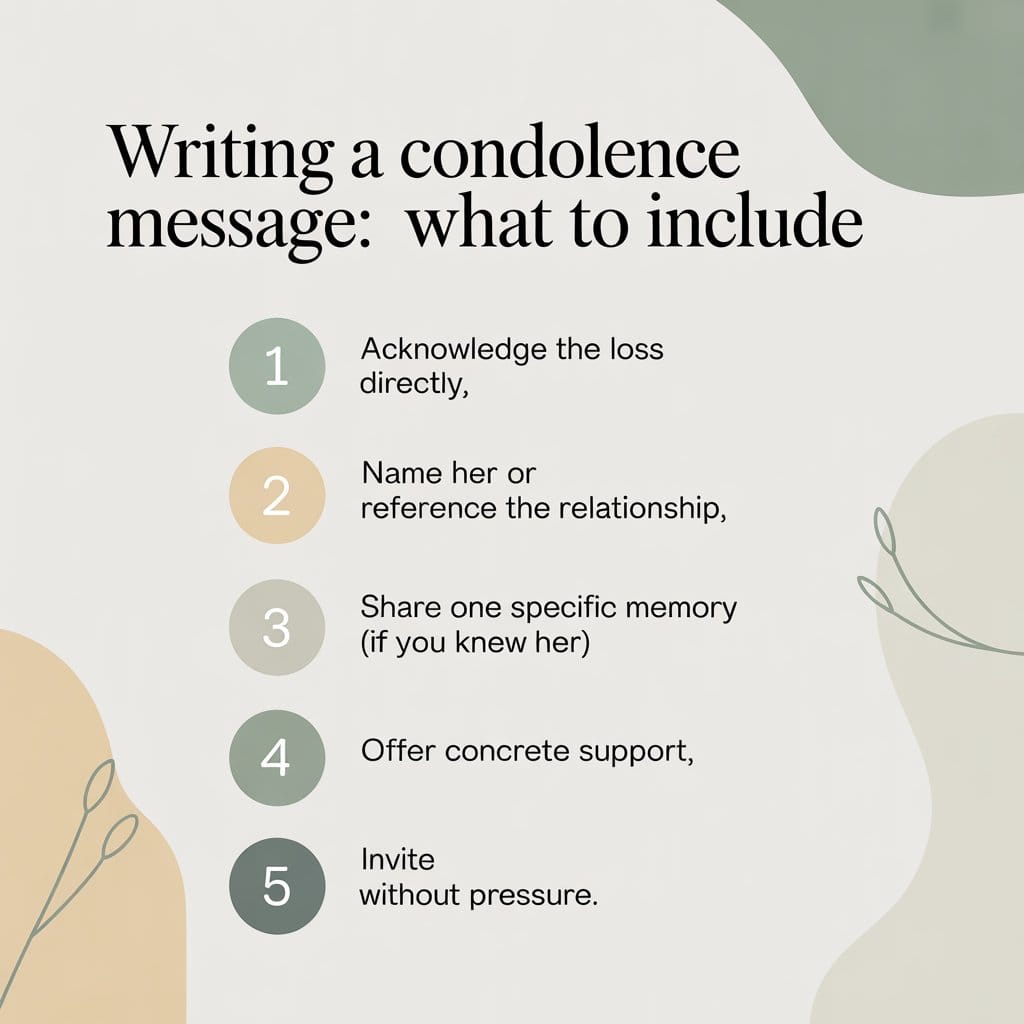
Every effective condolence message for the loss of a mother tends to include most of the following:
- Acknowledgement — recognise the loss directly
- Recognition — name her, or reference the relationship specifically
- A specific memory or quality (if you knew her)
- Validation — let them know their grief is understood
- A genuine, specific offer of support
- An invitation without pressure — "no need to reply"
Not every message needs all six. A text sent in the first hours might only need the first two. A handwritten card sent a week later can include all of them.

Condolence Messages for the Loss of a Mother: By Relationship
Short Condolence Messages for the Loss of a Mother
These work well as texts, brief social media messages, or as opening lines in a card when you plan to add your own words underneath.
- "I'm so deeply sorry to hear about your mother. Thinking of you and your family."
- "There are no words for a loss like this. I'm so sorry. I'm here."
- "Your mother was a wonderful woman. I'm heartbroken for you."
- "Sending you so much love right now. You are in my thoughts constantly."
- "I'm so sorry. Please know I'm here for whatever you need."
- "She raised someone extraordinary. Her love lives on through you."
- "Thinking of you and holding you close in my thoughts today."
- "She was so loved. I'm here whenever you are ready."
- "I can't imagine the pain you are in right now. I'm so sorry. I'm right here."
- "No words are enough. Just know you are not alone."
Condolence Messages for a Friend Who Lost Their Mother
These messages are written for close friends — people with whom you have a genuine, warm relationship and who will want to feel truly seen in their grief.
- "I cannot find words big enough for this. Your mother was one of the most generous, warm people I have ever met, and the way she loved you was evident in everything she did. I'm so sorry. I'm not going anywhere, and I mean that."
- "I keep thinking about all the times she welcomed me into your home like I was part of the family. She had a way of making everyone feel completely at ease. I'm heartbroken for you, and I love you so much."
- "She raised the kindest, most wonderful person I know. That is her legacy, and it is immense. I'm here for you — today, next week, next month, whenever you need me."
- "I know there is nothing I can say that takes this away. But I want you to know I'm with you in it. Whatever you need — someone to talk to, someone to sit in silence with, help with the practical things — just say the word."
- "Your grief is proof of the most extraordinary love. I'm so sorry for your loss, and so grateful I got to know her, even a little."
- "I have been thinking about you nonstop since I heard the news. I know how much she meant to you. I know this changes everything. I'm here. I love you."
- "She wasn't just your mother — she felt like a second mother to so many people who came through your door. Her warmth was genuinely rare. I'm so sorry."
- "I'm bringing dinner over on Thursday. I'll message you first. You don't need to do anything, say anything, or be anywhere except wherever you need to be right now."
- "There is a particular kind of quiet that comes after losing your mother, and I don't want you to sit in it alone. Please call me any time."
- "She was so proud of you. Every time I saw you both together, it was completely clear. That pride was one of her greatest gifts, and it doesn't go anywhere."

Condolence Messages for a Colleague Who Lost Their Mother
Professional relationships call for a different tone: warm and human, but not so familiar that it oversteps.
From an individual colleague:
- "I was so sorry to hear about your mother's passing. Please know that you have full support and there is absolutely no pressure on you right now. Take the time you need to be with your family."
- "I wanted to reach out personally to say how sorry I am. Please don't worry about anything here — everything is covered. You are in my thoughts."
- "I heard the news and I just wanted you to know I'm thinking of you. Please take all the time you need. I'm here if there's anything I can do."
- "I'm so sorry for your loss. Please know we are all here to support you however we can."
- "Please take whatever time you need — nothing here matters more than you being with your family right now. My sincere condolences."
From a team or on behalf of a department:
- "On behalf of the whole team, we wanted to extend our deepest sympathies on the loss of your mother. We will cover everything so that you can be fully present with your family. Our thoughts are with you."
- "We were all saddened to hear about your mother's passing. Please take all the time you need — your wellbeing is what matters most right now."
- "The team sends its sincerest condolences. Please know that everything is in hand and there is nothing to worry about here. Take care of yourself and your family."
From a manager:
- "I wanted to reach out personally to offer my deepest sympathies. Please take as much time as you need and be reassured that your responsibilities are fully covered. Your wellbeing comes first."
- "I'm so sorry to hear this news. Please take all the time you need. The team is in good hands."
Condolence Messages for a Family Member Who Lost Their Mother
For a sibling:
- "She loved you so completely. I know that doesn't make this easier, but I hope you can hold onto it. I'm here with you in this — every step."
- "Losing her together makes it different from any other loss. I'm glad we have each other. I'm here for you however you need me to be."
- "I know how close you two were. I know you were there for her. She knew how loved she was because of you. I'm so sorry for your pain."
For an extended family member:
- "I was heartbroken to hear about your mother's passing. She was such a central figure, and her warmth touched everyone around her. I'm thinking of you and your whole family."
- "She was such a special woman. I'm so sorry for your loss, and for all of ours. Please know that I'm here for whatever you need."
- "She meant so much to so many of us. I'll treasure every memory I have of her. Sending you so much love."
When You Didn't Know Her Personally
It is entirely possible to send a meaningful condolence message even if you never met the person's mother. The focus simply shifts to the person who is grieving.
- "I may not have had the chance to meet your mother, but from everything you have shared over the years, it is clear she was an exceptional woman. I'm so sorry for your loss."
- "I didn't know your mother personally, but I know you — and anyone who raised someone as wonderful as you must have been extraordinary."
- "I know we haven't been close recently, but I heard the news and couldn't not reach out. I'm so sorry. I hope you are surrounded by people who love you."
Condolence Messages by Situation
When Her Death Was Sudden or Unexpected
Sudden loss carries its own particular devastation. Acknowledge the shock without trying to explain or make sense of it.
- "There are no words for something like this. The shock of it must be overwhelming. I'm so deeply sorry. I'm here and I mean it."
- "I don't even know how to begin. I'm so, so sorry. Please don't be alone with this. Call me any time."
- "Sudden loss is its own particular kind of pain. There's no way to prepare for it. But you don't have to face it alone. I'm right here."
- "I keep thinking of you and feeling the enormity of it. She was taken too soon, and that is a terrible thing."
- "I know you are probably still in shock right now. That is completely understandable. Just know I'm here — not just today, but in the weeks ahead when the shock begins to lift."
- "There's nothing to say that makes this better. I just want you to know I'm with you, I love you, and I'm not going anywhere."
When She Died After a Long Illness
Loss after long illness carries a complicated mix of grief, relief, and sometimes guilt about the relief. A good condolence message acknowledges the difficulty of everything leading up to the death — not just the loss itself.
- "I know you have been carrying this for a long time. I hope there is some peace in knowing her suffering is over, even though losing her doesn't hurt any less. You were extraordinary in the way you supported her."
- "The grief that comes after watching someone you love decline slowly is unlike any other. You have been mourning in stages, and now you are allowed to stop being strong. I'm here."
- "You gave her such devoted care. She was so lucky to have you by her side. I'm so sorry that this chapter has ended."
- "Anticipating a loss doesn't protect you from it. I know this didn't come as a surprise, but that doesn't mean it doesn't hurt. I'm thinking of you."
- "After everything you have been through, I hope you can take time to rest and grieve properly. You did everything right by her. I'm here when you're ready."
- "You were there for every difficult moment. She knew she was loved, completely and without condition. That is a profound thing."
When She Died in Older Age
The assumption that old age makes a loss easier to bear is rarely true. A mother is a mother at any age.
- "A long life doesn't make the loss any smaller. She was your mother, and losing her is losing her. I'm so sorry."
- "She lived such a remarkable life, and from everything you've shared, she filled every year of it. What a woman. I'm so sorry you are saying goodbye."
- "A hundred wonderful memories doesn't make it easier to stop making them. I'm so sorry for your loss."
- "She clearly knew real strength, and she passed that on to you. I'm thinking of you and sending love."
Belated Condolences
It is always better to reach out late than not at all.
- "I have been thinking about you since I heard the news and I realise I should have reached out sooner. I'm so sorry. I hope you are being gentle with yourself."
- "I know this message comes later than it should, and I'm sorry for that. I have been holding you in my thoughts and I wanted you to know."
- "Time has passed, but my thoughts haven't left you. I hope the grief is settling into something softer. I'm here whenever you want to talk."
- "I should have written sooner. I didn't quite know what to say, and then time moved. But I want you to know I have been thinking of you, and of her, ever since."

By Format: Writing the Right Message for Each Medium
Condolence Text Messages
Text messages are appropriate for close relationships and for the immediate period after the news. They should be brief, warm, and free of any expectation of reply.
What works in a text:
- 1-3 sentences maximum
- Express that you are thinking of them
- Offer to be there without asking them to organise you
- End naturally — "no need to reply" is always fine to add
Examples:
"Just heard. I'm so devastated for you. I love you. No need to reply."
"Thinking of you constantly. I'm here whenever you're ready."
"I'm so sorry about your mother. I'll check in over the next few days. Just know I'm here."
"No words. Just love. I'm here for whatever you need."
Condolence Emails
Email is common in professional contexts or when you don't have a postal address. Slightly longer than a text, but still focused.
Subject line suggestions: "Thinking of you" / "My condolences" / "I'm so sorry" / "With sympathy"
Example 1 — close colleague:
Subject: Thinking of you
Hi [Name],
I just wanted to reach out to say how sorry I am to hear about your mother. I know how much she meant to you.
Please don't worry about anything here — everything is covered and there is absolutely no pressure on you. Take all the time you need.
I'm thinking of you and sending love.
[Name]
Example 2 — more formal:
Subject: My sincere condolences
Dear [Name],
I was deeply saddened to hear about the passing of your mother. From everything you have shared over the years, it is clear she was a remarkable woman, and the love between you was obvious to anyone who saw you together.
Please take whatever time you need to be with your family. I have spoken with the team and all of your responsibilities are fully covered.
I am here if you want to talk, and please know my thoughts are very much with you.
Warmly, [Name]
Handwritten Condolence Cards
A handwritten card remains the most meaningful format. It signals that you stopped, thought, and took time — something recipients rarely forget.
Tips:
- Write in blue or black ink
- If you knew the mother, include one specific memory — even a single sentence transforms a generic card into a keepsake
- 3-5 sentences is usually right; two genuine sentences beat five generic ones every time
- Do not feel you need to fill white space
Card examples:
"Dear [Name],
I was heartbroken to hear about your mother's passing. She had such warmth about her — I'll never forget how welcoming she always was. You gave her so much love and care, and she knew it.
Please know I'm here for you. I'll check in next week. No need to respond to this.
With love, [Name]"
"Dear [Name],
I'm so deeply sorry. Your mother was an exceptional woman — kind, funny, and so clearly devoted to you all. Her presence will be missed more than words can say.
I'd love to bring dinner over this week if that would help. I'll message you.
Sending all my love, [Name]"
"Dear [Name],
There is no card that does justice to a loss like this. I just want you to know that I am thinking of you, that I loved your mother, and that I am here for you for as long as you need me.
With so much love, [Name]"
Personalising Your Message: The One Thing That Matters Most
The single most effective way to personalise a condolence message is to include one specific memory, observation, or quality.
Generic phrases like "she will be deeply missed" and "she was such a wonderful woman" are not wrong — but they can apply to anyone. A specific detail cannot.
Generic vs. specific:
Generic: "She was such a kind and generous person." Specific: "I'll never forget how she always had a pot of coffee on before you'd even taken your coat off."
Generic: "She clearly meant everything to you." Specific: "The way your face changed whenever you talked about her — it was always obvious just how much she loved you."
Generic: "She left a lasting impression on everyone she met." Specific: "I still remember meeting her at your graduation. She kept saying how proud she was. You could hear it in everything she said."
If you did not know the mother personally, draw specifics from what you know about the person you are writing to:
"I may not have met her, but I know you — and from everything you've shared over the years, she shaped the most remarkable parts of who you are."
Supporting Someone Beyond the First Message
The condolence message is the beginning, not the end, of support. Grief for a mother tends to intensify around specific moments that come later:
- The first birthday after the death
- Mother's Day
- The anniversary of her passing
- Family occasions she would normally have attended
- The first time the person reaches for the phone to call her and remembers they cannot
A message sent on any of these dates — "I've been thinking of you today, and thinking of your mother" — is often more meaningful than anything sent in the first week.
Practical support matters equally in the weeks that follow. By then, the meals have stopped arriving and people have returned to their own lives. Being the person who checks in at six weeks or three months is something that is rarely forgotten.
Frequently Asked Questions
How long should a condolence message for the loss of a mother be?
There is no ideal length. Three sincere sentences will always outperform a long message that circles without landing. For handwritten cards, 3-5 sentences is usually right. For emails in a professional context, 4-6 sentences. For texts, 1-3 sentences.
Should I mention how she died?
Generally, no. Unless the person you are writing to has raised it themselves, focus on the loss and your support rather than the circumstances of the death.
What if I don't know the mother's name?
"Your mother" or "your mom" is always appropriate. If you know her name, use it — it makes the message feel more personal.
Is it appropriate to acknowledge my own grief?
If you knew her well yourself, briefly acknowledging your own sadness can be genuine and connecting. Keep it brief though — a condolence message should primarily focus on the person who is grieving, not on your own feelings.
What if I've left it too long?
Send the message anyway. Late is always better than never. Acknowledge the delay briefly — "I know this is later than it should be" — then focus on the condolence itself.
Can I share a funny memory?
Yes, if it reflects the deceased warmly and you know your audience well. Grief and warmth are not opposites. A gently humorous memory — the kind that brings a smile even through tears — can be one of the most comforting things a message contains.
From Condolence to Memorial: Honouring Her Permanently
When the time comes to think about a permanent memorial, the same challenge applies: finding words that are true, specific, and worthy of the person who has died.
Our guide to short beautiful words for gravestones for parents offers inscription ideas written specifically for mothers and fathers. Our wording for memorials guide covers the full range of options across different memorial types, and our memorial quotes collection includes quotations well suited to memorials for mothers.
For practical guidance on the inscription itself, our guides on epitaphs for headstones and what to write on a headstone walk through the decisions in detail. Our heartfelt sympathy messages guide covers additional message examples across other relationships, and our complete guide to funeral readings, poems, and verses is useful if you are preparing something to read at the service. If you are helping write a eulogy, our guide on how to write a heartfelt funeral tribute covers the full process.
Creating a Lasting Memorial for a Mother
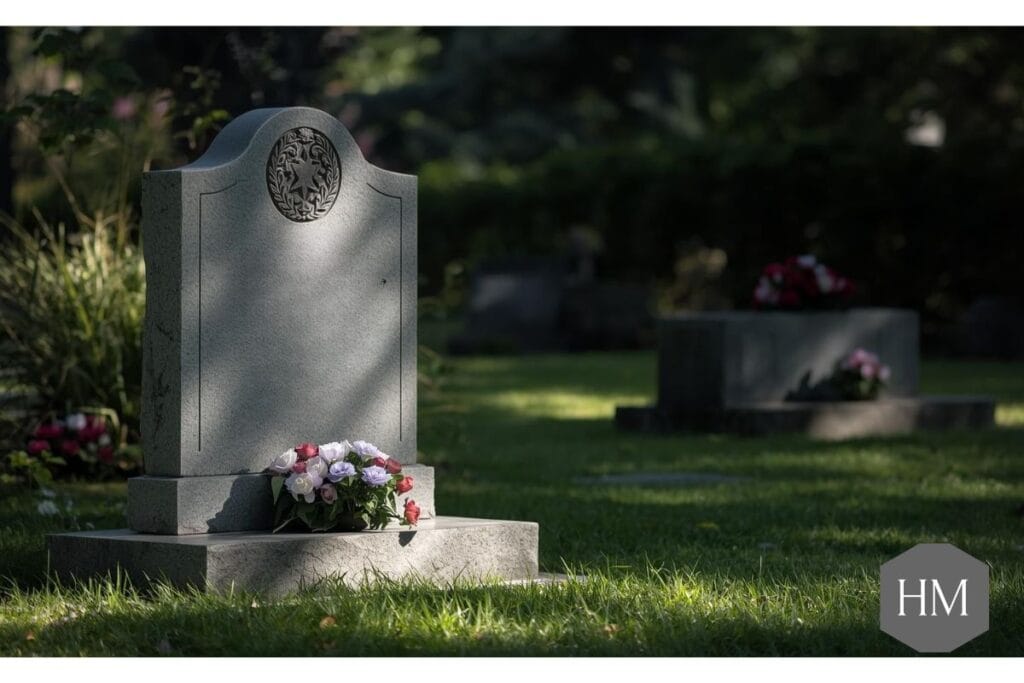
At Haven Memorials, we work with families throughout Hampshire, Berkshire, Oxfordshire, and Surrey to create handcrafted memorials that genuinely reflect the person being honoured. Every memorial is bespoke and made to order at our workshop in Fleet, Hampshire.
We offer a full range of cemetery memorials, cremation memorials, kerbed memorials, heart-shaped memorials, book memorials, and memorial vases. For families thinking about material choices, our guide to choosing the best material for headstones explains the practical differences between granite, marble, and natural stone.
To speak to our team about creating a memorial, contact Haven Memorials on 01252 811691 (Fleet) or 01256 811829 (Basingstoke), or email admin@havenstone.co.uk.
Receiving Condolences: How to Respond
If you have lost your mother and are unsure how to acknowledge the messages you are receiving, our guide on how to respond to condolence messages offers practical advice. The short answer: you are not obligated to respond to every message, and you certainly do not need to do so immediately. A simple acknowledgement is always enough.
For condolence messages covering other relationships — loss of a friend, sibling, spouse, or child — see our complete condolence message guide with 200+ examples.